


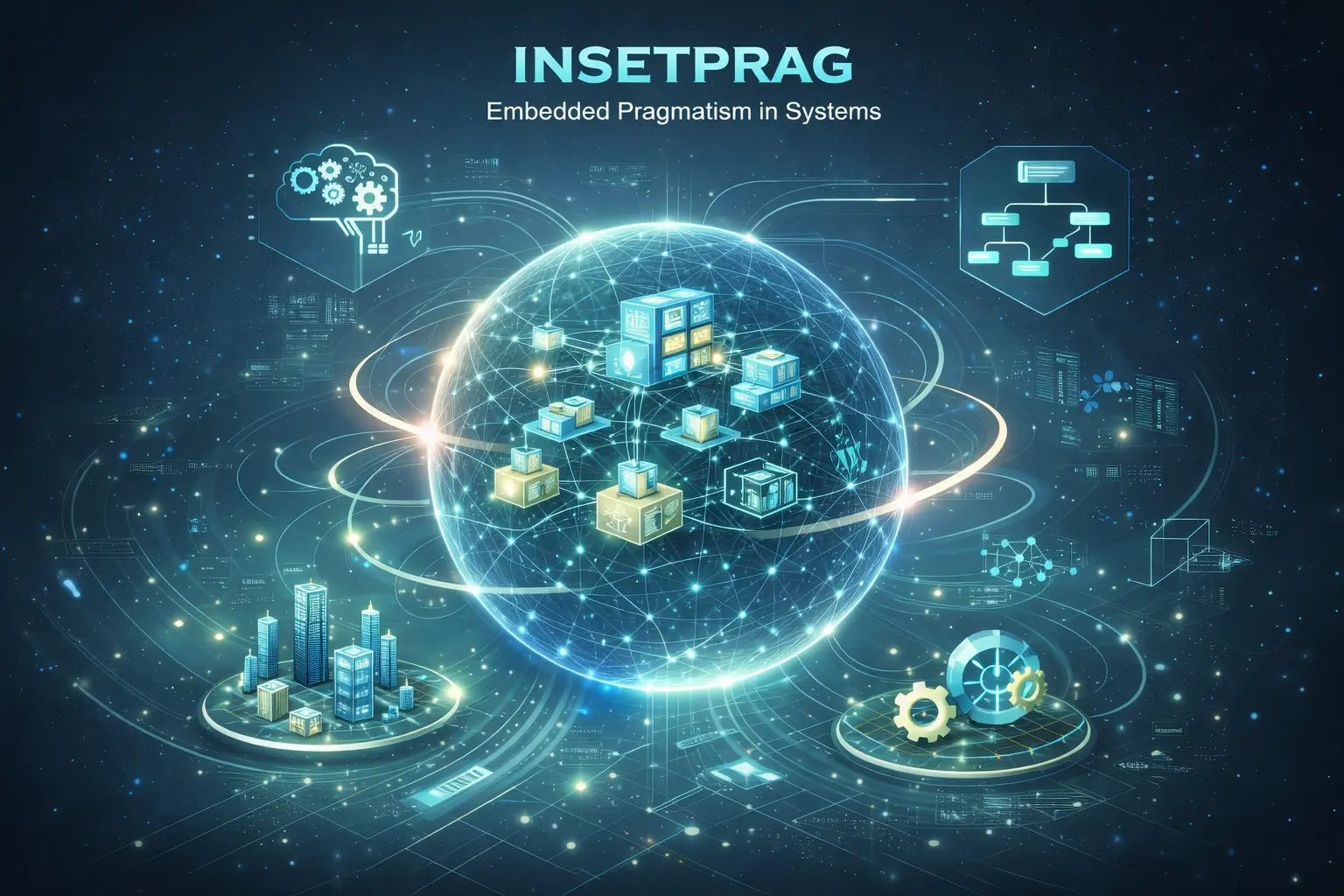
Insetprag is a term that combines the idea of something embedded or inserted, with the notion of pragmatism, meaning practical and useful logic. Put together, insetprag refers to embedded pragmatism, a concept where practical decision-making and adaptive problem-solving are integrated directly into systems rather than being external or applied as an afterthought. The principle is gaining attention in technology, business, education, and urban planning because modern systems are expected to do more than function they need to respond intelligently to changing environments.
Historically, the roots of insetprag can be traced back to systems thinking and pragmatic philosophy. Traditional pragmatism evaluates actions based on results and real-world effectiveness. Insetprag extends this concept by suggesting that systems themselves should contain the mechanisms for making practical, context-aware decisions. This makes it especially relevant in artificial intelligence, smart infrastructure, business processes, and any system where constant human intervention is not feasible.
Quick Bio
| Feature | Details |
|---|
| Term | Insetprag |
| Meaning | Embedded pragmatism; practical logic built into systems |
| Origin | Combines “Inset” (embedded) + “Prag” (pragmatic) |
| Core Idea | Systems that adapt intelligently and act practically |
| Key Principles | Contextual awareness, embedded logic, modularity, continuous feedback |
| Application Areas | AI systems, smart infrastructure, business workflows, education |
| Benefits | Faster decisions, adaptability, cost efficiency, continuous improvement |
| Challenges | Complexity, resource needs, balancing flexibility with stability |
| Comparison | Different from Agile/Lean; focuses on internal adaptability |
| Real-World Examples | AI recommendation engines, smart traffic systems, adaptive LMS, workflow optimization |
| Future Trends | Growth in AI, IoT, smart cities, adaptive learning systems |
| FAQs Addressed | Definition, concept vs technology, personal use, difference from optimization |
The Core Principles of Insetprag Explained
Insetprag is built on several core principles that guide its application. First is contextual awareness. Systems designed under insetprag continuously observe and analyze their environment, capturing changes in conditions, user behavior, and external influences. This allows the system to respond in real time instead of relying on pre-programmed rules alone.
Second, embedded pragmatic logic is a foundation of insetprag. Systems are designed to prioritize actions that provide real-world benefit rather than following theoretical ideals. In other words, decisions are made based on practicality and effectiveness. Third, modularity and scalability are key. Insetprag systems are composed of components that can be updated, replaced, or scaled without breaking the overall framework. This ensures that improvements or adjustments are easily integrated as conditions evolve.
Fourth, continuous feedback and iteration are central to insetprag. Systems are not static; they learn from results, refine their strategies, and enhance performance over time. By integrating these principles, insetprag ensures that systems remain adaptive, efficient, and effective, creating solutions that are both flexible and grounded in practical outcomes.
How Insetprag Works: A Practical Framework
The practical application of insetprag involves embedding mechanisms that allow a system to sense, decide, and adapt. The process starts with data collection. Sensors, user inputs, or environmental feedback provide the system with context. The system then evaluates the data using pragmatic rules or algorithms that prioritize real-world effectiveness. Based on the analysis, it selects actions that optimize outcomes, implementing changes automatically.
For instance, in a business setting, an insetprag-enabled workflow system would monitor task completion rates, detect bottlenecks, and automatically adjust team assignments or deadlines to maintain productivity. In a smart city traffic management system, insetprag allows traffic lights, digital signage, and vehicle routing to adjust dynamically to congestion, accidents, or weather changes.
The framework relies on modular components such as decision modules, feedback loops, and adaptive algorithms. Feedback loops ensure that results are measured, allowing the system to continuously refine its responses. Over time, this approach allows systems to operate autonomously while remaining practical, efficient, and aligned with real-world objectives.
Insetprag in Action: Real-World Examples
Insetprag can be observed in multiple domains. In technology, adaptive AI systems use insetprag to adjust algorithms based on user behavior and context, improving personalization and efficiency. For example, AI-powered recommendation engines on streaming platforms adapt in real time to viewer preferences and engagement patterns.
In business, insetprag principles are applied to workflow optimization. Companies implement systems that continuously monitor performance metrics, identify inefficiencies, and apply adjustments automatically. This reduces downtime and operational costs without requiring major structural changes.
Education also benefits from insetprag. Learning management systems can integrate adaptive modules that assess student performance and suggest personalized study paths, automatically adjusting difficulty or focus areas. Urban planning applies insetprag in smart infrastructure, where systems for energy, traffic, and water management adjust automatically based on real-time conditions, creating sustainable and responsive urban environments.
A simple example table showing practical use cases:
| Domain | System | Insetprag Feature | Outcome |
|---|---|---|---|
| Technology | AI Recommendation Engine | Adjusts suggestions based on real-time engagement | Higher user satisfaction |
| Business | Workflow Management | Monitors tasks, reallocates resources dynamically | Improved efficiency |
| Education | LMS | Adapts difficulty and learning path | Personalized learning |
| Urban Planning | Smart Traffic | Adjusts traffic signals based on congestion | Reduced delays |
Insetprag vs Other Frameworks: What Makes It Different
Insetprag differs from traditional frameworks like Agile or Lean in its emphasis on embedding adaptability within the system itself rather than adding iterative improvements externally. While Agile relies on frequent human-driven updates and Lean focuses on efficiency improvements, insetprag builds practical adaptability directly into the system’s architecture.
Traditional systems often require external analysis and intervention to remain relevant, whereas insetprag systems autonomously sense changes, evaluate actions, and apply adjustments. This difference makes insetprag especially suited for environments where rapid responses and real-time decisions are critical, such as AI platforms, smart infrastructure, and high-speed business processes.
Benefits of Adopting Insetprag
Adopting insetprag offers several advantages. It improves adaptability, allowing systems to respond effectively to unforeseen changes. Decision-making becomes faster and more efficient since the system can act autonomously based on embedded pragmatic logic. Operational costs can be reduced because the system identifies and corrects inefficiencies without human intervention.
Additionally, insetprag supports continuous learning. By integrating feedback loops, systems refine their actions over time, becoming more effective. Organizations using insetprag principles often report better alignment between system outputs and real-world objectives, whether in technology, business, education, or urban planning.
Challenges and Misconceptions About Insetprag
Despite its benefits, insetprag is sometimes misunderstood. One misconception is that it eliminates the need for human oversight. In reality, while insetprag systems reduce intervention, human monitoring remains important for supervision, ethical decisions, and complex problem-solving.
Implementation challenges include complexity, transparency, and resource requirements. Building systems with embedded adaptability requires careful design, sufficient data, and robust testing. Another challenge is balancing flexibility with stability; overly adaptive systems may become unpredictable if not properly constrained. Understanding these limitations is crucial for effective deployment.
The Future of Insetprag: Trends and Prediction
The future of insetprag is promising, especially as AI, IoT, and smart systems continue to grow. Systems that can sense, analyze, and adapt autonomously are increasingly necessary in environments with high data volumes and rapid change. Experts predict that insetprag principles will influence the next generation of AI platforms, autonomous vehicles, smart cities, and adaptive learning technologies.
As organizations seek efficiency, responsiveness, and sustainability, insetprag will become a foundational approach in system design, enabling real-world practicality and continuous improvement across multiple sectors.
Conclusion
Insetprag is a modern approach that emphasizes practical decision-making embedded directly into systems, allowing them to adapt intelligently to changing conditions. By integrating principles like contextual awareness, modularity, and continuous feedback, insetprag helps systems become more efficient, responsive, and aligned with real-world needs. From AI platforms to smart infrastructure, education systems, and business workflows, its applications are broad and impactful.
While implementing insetprag comes with challenges such as complexity and resource requirements, the benefits—faster decisions, continuous improvement, and real-time adaptability—make it a valuable framework for organizations and developers alike. As technology continues to evolve, insetprag will play an increasingly important role in creating systems that are not only functional but truly intelligent and practical.
Frequently Asked Questions About Insetprag
1.What is the simplest definition of insetprag?
Insetprag is embedded pragmatism, meaning practical decision-making built directly into systems so they can adapt and respond effectively without external intervention.
2.Is insetprag a method, idea, or technology?
It is primarily a conceptual framework and philosophy that guides system design. It can also be implemented through technology in software, AI, or smart systems.
3.Can individuals use insetprag personally?
Yes, the principles of embedded practicality and adaptive decision-making can be applied to personal workflows, learning systems, or small-scale automated processes.
4.How is insetprag different from traditional optimization?
Traditional optimization often requires external analysis and manual adjustment. Insetprag integrates adaptability within the system itself, allowing real-time, autonomous decision-making.
Read More : What Is Serlig Meaning, Origins, Uses and Why It Matters
